CreepyDates on Android: Gameplay, Controls, and What It Costs You
CreepyDates gameplay on Android explained: how it plays, controls on a phone, progression, and the trade-offs before you download it.
App summary
- App
- CreepyDates
- Developer
- Hahadit
- Size
- CreepyDates-ANDROID 476 MB
- Price
- Name your own price
CreepyDates is a creepypasta dating sim and visual novel from solo creator Hahadit, offered on itch.io for Windows, macOS, Linux and Android. You customize an avatar, move through the Creepy House, collect items and talk your way through six routes built around familiar internet horror characters: Jeff the Killer, Eyeless Jack, Ben Drowned, Ticci Toby, Masky and Hoodie, and Slenderman.
It is for readers who like fan visual novels, character banter and slow-burn route building more than jump scares.
How the game actually plays
Structurally it is a visual novel: static scenes, portrait-style dialogue boxes, and reply choices that nudge a per-character affection value. You begin by building your own avatar, then settle into the Creepy House, where rooms act as menus for story beats, item pickups and character encounters. Everything advances in chapter order, so you cannot skip ahead to a later route by accident.
The affection system is what decides which route stays open. Spread your attention across everyone, or pick the wrong answers too often, and a route locks without much warning, pushing the story toward a hidden trigger or a bad ending instead. That is the actual game under the jokes, and it is why replays matter.
Item collection is the lighter half of the loop. Objects found while exploring the Creepy House unlock scenes, gags or small callbacks, and they reward players who poke around every room rather than rushing dialogue. It is not a puzzle game, but exploration is how the writing opens up and how the house stops being just a backdrop.
Because the whole thing is text-led, there is no action layer and no timer. Pacing is yours to set, which suits phone play in short bursts, but it also means the interface carries a lot of weight. If the boxes are unclear, you feel it immediately, because reading is the entire interaction.
The Android file, APK safety, and browser versus app
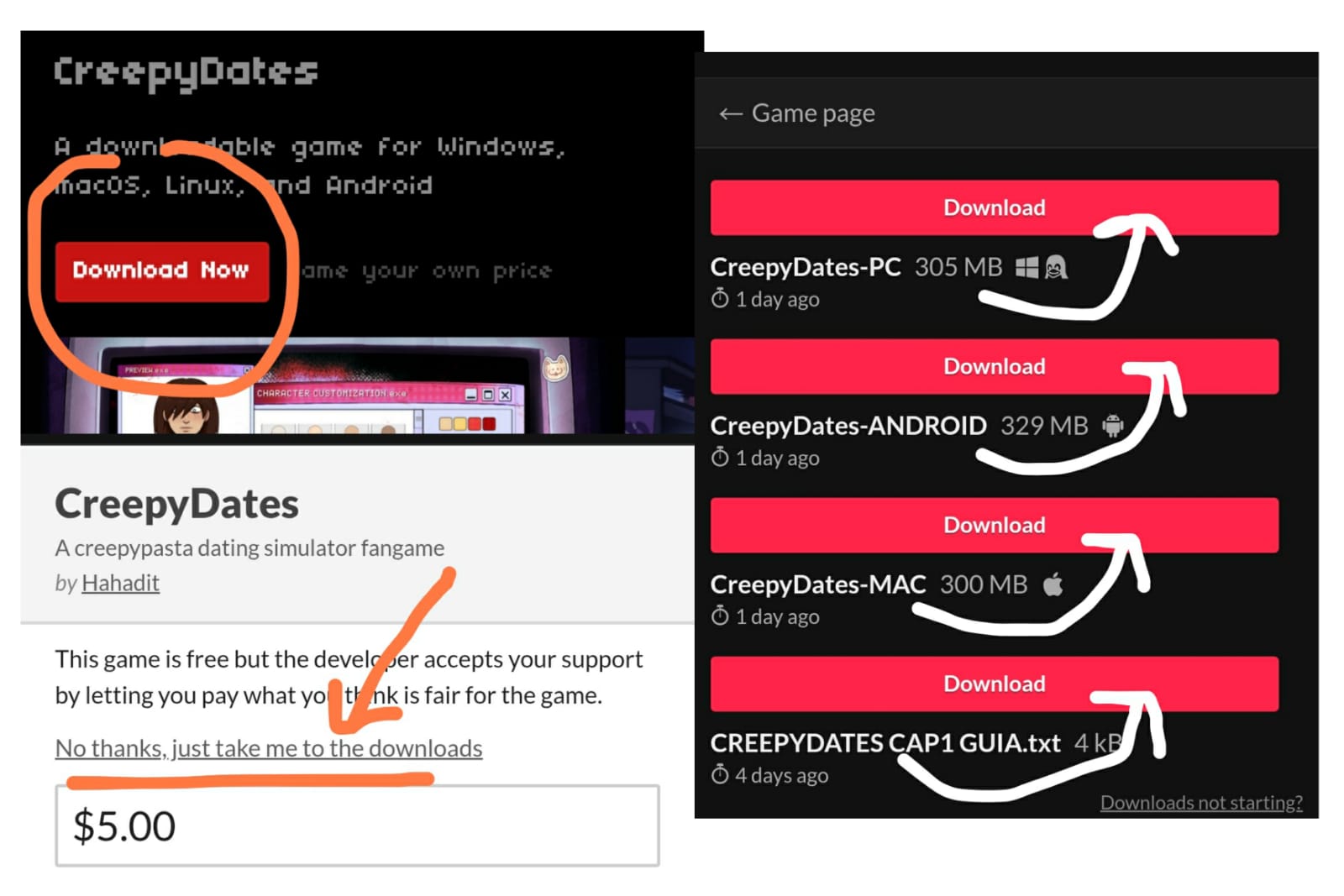
The itch.io page lists platform builds as downloads, including a dedicated Android file of 476 MB. The phone route is therefore a download-then-install job: your browser fetches the file from the page reached through the official link, and Android asks you to allow installs from that browser before it continues. That extra permission prompt is normal, not a warning sign.
APK safety here depends on the source rather than on a scanner. The file sits on the developer’s own Hahadit itch.io account, so it comes from the author’s upload, which is the only source worth trusting for a sideloaded build. A copy reposted on an aggregator site is a different risk entirely, and there is no reason to accept it.
The page gives no licence identifier and no privacy or data-collection notes, so the install prompt itself is your main reference for permissions. Check what the app asks for before you confirm, and if something looks unrelated to a single-player visual novel, stop there. That is the honest limit of what the listing tells you.
Browser versus app is a delivery difference here, not a rendering one. The Android option on the page is a downloadable build rather than an in-browser play link, so what you run is the installed app launched from your drawer. Content is the same: chapters, routes and the four language options.

Touch controls on a phone
Advancing dialogue is a tap, and that part behaves well, because most scenes treat the whole screen as the next-line button. The friction starts with the dialogue box layout itself. Reviewers on the page single out the UI as occasionally confusing, and boxes that read comfortably on a monitor feel crowded once they are squeezed onto a phone.
Reading order is the second issue, and the same feedback flags it directly: it can be hard to tell which character spoke first when several share a scene. On a small screen this gets worse, since your eye cannot sweep the whole layout at once. Expect to re-read a line or two before a conversation settles.
Menus are tap targets rather than gestures, so there is no swipe layer or hidden control scheme to learn. Language switching lives in the options menu, where Spanish is the original and English, Russian and Portuguese are selectable. When a tap misses, it is usually a small target rather than a broken input.
Progression and learning curve
Chapters 1 through 4 are available now, arriving across a long devlog trail that runs from the Chapter 2 announcement to the current Chapter 4 release. The learning curve is mostly about reading the room: which reply raises affection, which one quietly closes a route, and when the story is steering you somewhere you did not choose.
Route locking is the real skill. The game rarely announces that a door has shut, so a first playthrough often ends on a thinner route than you planned. Hidden triggers and bad endings are part of the design rather than a failure state, and a second run with one character in focus is usually cleaner than the first.
Because this is a single-developer project still in development, the route list is not final. More routes and characters are planned but not yet added, so the four available chapters are a slice of a larger map, not the finished shape of the game. Plan your expectations around that.
What you do in a session
A sitting is usually one chapter, or a chapter plus a cleanup pass through the house. You read scenes, pick replies, sweep rooms for items you missed, and judge your route by how characters respond rather than by reading a meter. The game hands you no explicit score screen to grind against.
Sessions also double as save-scumming sessions for route hunters: reload a branch, try the colder reply, watch affection shift. The writing rewards that fiddling, because the humor lands in alternate lines, not only on the main path. That is where the replay value actually comes from.
If you only have a short break, the tap-to-advance pace suits it. You can stop mid-conversation, and because this is an installed app, nothing about the play session depends on a live connection once the file is on your phone. There is also a chapter guide to follow in the devlog if you lose the thread.
Performance and size reality
Size is the number worth checking before you commit storage. The Android build is 476 MB, which is actually the largest of the three: the Windows file is 454 MB and the macOS file 448 MB. That is a normal visual-novel footprint, but it is not a trivial download on a phone that is already full of photos.
Minimum requirements are not published on the page, so there is no spec list to match against your device. What you can judge is load behaviour: asset-heavy visual novels tend to stutter during scene changes rather than mid-dialogue, so free storage headroom matters as much as raw processor speed.
Offline play is the practical upside. Once installed, the app ships its assets and language files locally, so reading sessions do not need a connection. Compare that with browser-hosted visual novels, which need the page live on every load; that alone is a good argument for the downloaded build.
| Aspect | Android build | Windows and macOS builds |
|---|---|---|
| Download size | 476 MB | 454 MB (Windows), 448 MB (macOS) |
| Price | Name your own price | Name your own price |
| Offline play | Runs from the installed app | Runs from the installed file |
| Controls | Tap to advance, tap targets in menus | Mouse clicks and keyboard |
| Progression | Chapters 1–4, six routes | Chapters 1–4, six routes |
Strengths
The writing is the draw, and it holds across routes. Reviews on the page describe the game as genuinely fun, with a script funny enough to earn real laughs. That tone matters in a genre that often takes itself too seriously, because the jokes carry the slower house-exploration stretches.
Distribution is generous for a fan project: name your own price, four platforms, and four interface languages, with Spanish as the original and English, Russian and Portuguese available in options. Very few single-developer visual novels offer that spread without sitting behind a storefront.
Six routes and four chapters is a lot of text already, and the affection system gives the choices weight. A replay is not the same scenes with a swapped portrait; it is a different set of replies that decide whether you get the character you wanted.
Weaknesses
The interface is the weak point, and the page’s own reviewer feedback says so: confusing dialogue boxes and uncertainty about who is speaking in what order. Those are fixable problems, but they hit hardest on a phone, where you have less room to disambiguate a crowded scene.
It is also unfinished and made by one person. More routes and characters are planned but not added, chapters arrive on a devlog schedule, and there is no stated licence or published minimum requirements to plan around. That is ordinary for itch.io, and it is still what you are buying into.
Privacy and data handling are undocumented on the listing. Anyone cautious about permissions is working from the APK’s own install prompt rather than from a policy page. That is not a red flag by itself, but it is a gap worth noticing before you sideload anything.
Who should play it
Creepypasta fans who want character writing more than horror are the core audience. The routes lean on affection and banter, so if you came for dread you will find a dating sim wearing a mask; if you came for Jeff the Killer dialogue and jokes, it lands exactly as intended.
Phone-first readers with storage to spare will get along fine, especially people who play in short bursts and do not mind tapping through boxes. Desktop players get the more comfortable reading layout for the same price and a slightly smaller file, which is worth knowing. You can compare more Android titles in our games section.
Completionists should wait or replay later. Route hunters who enjoy testing hidden triggers and chasing a bad ending have enough here right now. Anyone who needs a finished, documented product should treat this as early access in all but name, and readers who like handheld management ports can also look at our Mindustry coverage for a very different use of screen time.
Verdict
CreepyDates is a good fan visual novel with an honest price and a real Android build, and its 476 MB download is the only place where the phone version costs you more storage for the same content. The writing carries it; the interface is the part that still needs work.
On a phone, the touch controls are simple, and the dialogue boxes are not. If you can forgive re-reading a line and you enjoy the humor, installing the official build is worth the sideload — just take it from the developer’s page, not from a mirror. For more phone-friendly picks, browse the rest of our Android game coverage.
If the premise sounds fun, start with the first hour: install from the official page, set your language, build an avatar and commit to one character early. You can grab it here: CreepyDates on itch.io.
Pros
- Rated 4.8 out of 5 stars from 2,196 total ratings
- Reviewer Cold_Kota: 'The game itself is lots of fun and the writing is very much fun and made me laugh a few times'
- Runs on Windows, macOS, Linux and Android, and is available as name-your-own-price
Cons
- Reviewer Cold_Kota: 'the dialog boxes and the UI could be a little confusing at times'
- Reviewer Cold_Kota: 'it was also difficult to tell in what order the characters were talking at times'
- Still in development with a single developer; more routes and characters are planned but not yet added
The link goes straight to Hahadit. We do not host app files.